

What the court strikes down, the Planning Authority resurrects
by Victor Paul Borg
July 2025
Abstract: The government of Malta, through the Planning Authority, has implemented a series of policy manoeuvres intended to neuter court decisions that revoked planning permits due to the excessive number of floors. This is likely to intensify density of development, population density, and congestion on the small islands of Malta. Neither has the Planning Authority paid heed to court judgments revoking permits for penthouses and swimming pools. The policy manoeuvres are an attempt to circumvent the law but do not change the law. This means any permits granted on the back of these changes are still likely to be revoked if challenged in court. This whole situation creates legal uncertainty for residents as well as for developers and investors.
Ten months ago, Chief Justice Mark Chetcuti warned public authorities that ignoring court judgements would be damaging to Malta’s democracy and Malta’s standing internationally.
He did not mention specific cases, but he is thought to have been referring to the Planning Authority’s regranting of a planning permit, less than two months earlier, for two penthouses that had been developed by property magnate Joseph Portelli. That permit was reissued in spite of having been revoked by the Chief Justice himself presiding over the Court of Appeal.
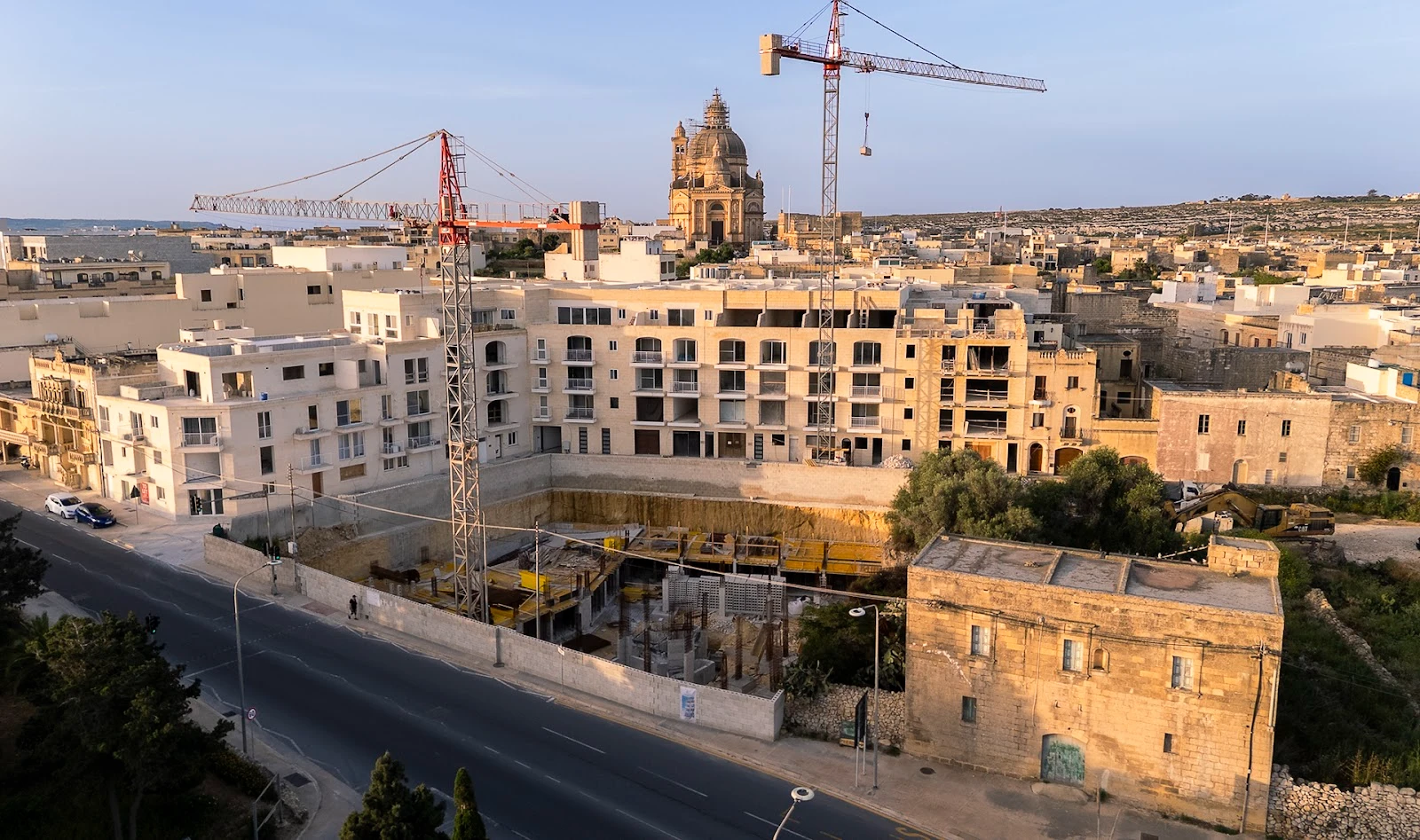
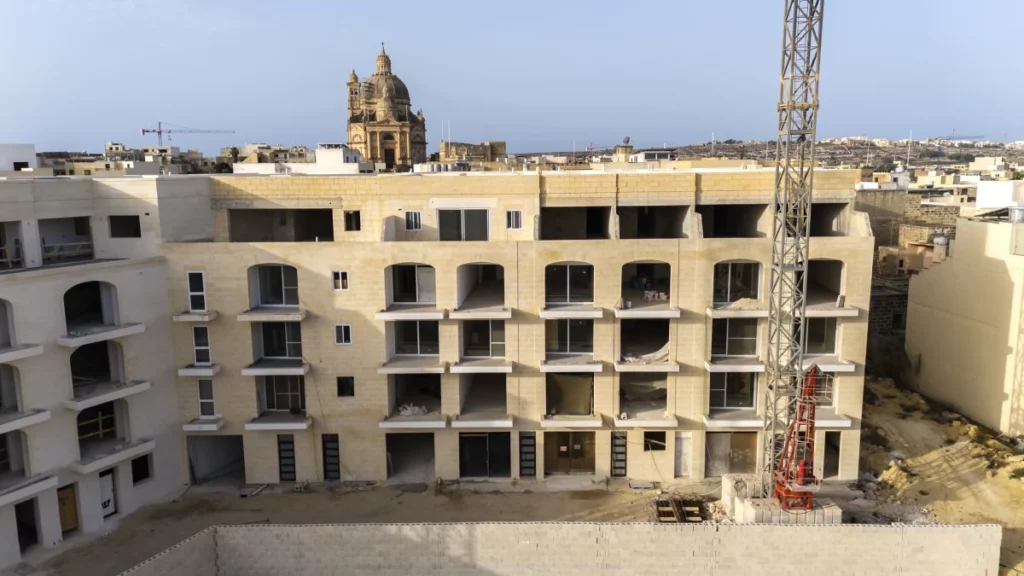
And despite the Chief Justice’s warning, the Planning Authority (PA) recently sanctioned another block of 29 flats whose permit had been revoked by the Court of Appeal because it had more stories than permitted by planning rules. This block of flats is in Xewkija, Gozo, and was developed by Francesco Grima, one of Gozo’s largest developers.
Grima’s block had been built by the time the court revoked its permit in November of 2023. Two applications were then put in to sanction the building “as built”. After processing these applications, the PA, in its Case Officer Report, maintained that five floors are permitted at the location – an insistence that defied the court’s reasoning. This position, it added, had now been “clarified by PA Circular 2/24”.
The reference to the circular was to one of the PA’s “policy manoeuvres” carried out in 2024 that were intended to shift the goalposts when it comes to the interpretation of building heights and number of floors.
The sanctioning of the Xewjika block appears to be the first time that various policy tweaks implemented in 2024 were deployed to redeliver a permit that had been revoked by the court.
Those policy manoeuvres had in fact been devised in response to court judgments that had revoked planning permits for developments that had more floors than specified in Local Plans. The Local Plans constitute the core blueprint for planning parameters.
Among the several large developments whose permits were revoked by the courts or planning tribunal since 2023 was the block of 29 flats in Xewkija (mentioned above), another block in Gozo of 54 flats at Ta’ Zejta, and a block redeveloped into 88 apartments and commercial spaces, called the Dolphin Centre, in Hal Balzan. The developments in Ta’ Zejta and Hal Balzan belong to Joseph Portelli and a range of business partners.
An investigation by this journalist can now report that, despite the policy manoeuvres, the detailed policy maps specifying height in floors within the Local Plans remain unchanged and so does the law. This situation “reflects a broader tension between policy and law in Malta’s planning system,” according to Joseph Mizzi, a lawyer who specialises in property law, including planning appeals.
In a legal opinion prepared for this investigation, Mizzi writes that instead of “amending the Local Plans through the proper legal process, the government has sought to reframe them through interpretation – a move that introduces legal and procedural uncertainty not only for residents but also for developers and investors who rely on predictable and enforceable planning rules.”
Article 52 of the Development Planning Act specifies that in the case of conflicts between Local Plans and other policies, including supplementary guidance policies such as DC15, the Local Plan takes precedence. One of the policy manoeuvres carried out in 2024 was a tweak to DC15 on height – creating a conflict with the Local Plan’s policy maps.
Another tweak was made in the document that interprets Local Plans. The intention was to bridge the Local Plans and Circular 2/24 mentioned above, and hence lead away from the Local Plans towards the new height limitation policies in DC15.
“The newly adopted interpretation is a policy manoeuvre, not a legislative change,” writes Mizzi. “It appears designed to provide the Planning Authority with a legal fig leaf – a justification to continue approving developments that exceed the floor limits set out in the Local Plans.”
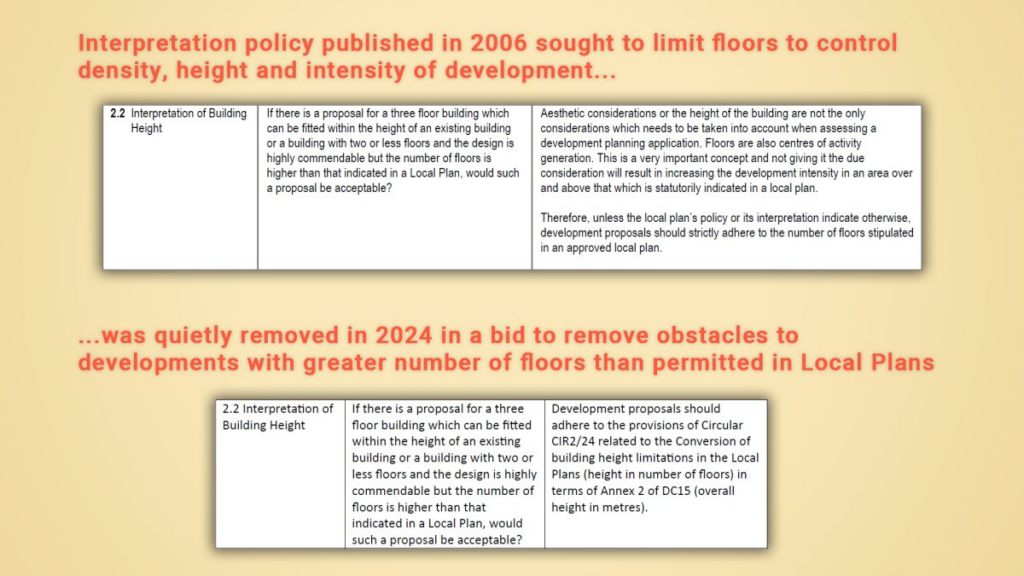
The change is radical: the government has now removed any mention of intensity of development, which was previously the argument put forth in the interpretation document to warn of the consequence of greater stacking in number of floors, and hence the importance of adherence to floor limits as laid down in the Local Plan.
The intention behind the government’s changes is to remove any constraints on height of buildings and number of floors arising from the Local Plans. This is set to intensify developments of densely stacked floors. The effect will be greater population density and congestion, and infrastructural bottlenecks.
It entrenches what Mizzi describes as “a silent but profound departure from what the Local Plans permitted.”
Alex Torpiano, dean of the Faculty of Built Environment at the University of Malta, said: “The vision is extremely short-sighted. Or rather, there is no vision. This is what worries me. This is also evident in the recently published Vision 2050. For example, on the one hand we want quality tourists but at the same time we project a higher number of tourists.”
The road to higher, denser buildings with greater stacking of floors had its tentative beginnings in 2015 with a table that Torpiano, who is also a council member of the heritage-protection NGO Din L-Art Helwa, and three NGOs (Wirt Ghawdex, Ghawdix and Din L-Art Helwa) are attacking in court. In an ongoing lawsuit, they argue that the table was introduced in its existing form by stealth.
The policy on heights, P35, and the table were published in November of 2015 in DC15 (formally called the Development Control Design Policy, Guidance and Standards 2015), setting height limitations in metres. In the lawsuit, Torpiano and the NGOs have shown evidence that the table was intended to be different from what was already published, and that it was intended merely as a “transitory provision” until Local Plans were reviewed.
“The plaintiffs strongly contend,” the lawsuit goes, “that Annex 2 and P35 of DC15 are simply serving as a clandestine and irregular manner to usurp that absolute primacy conveyed on the Local Plans by the principal law.
“Traditionally, Local Plans set height limits in terms of the number of floors, not metres,” Mizzi writes. “This was a deliberate choice to give communities and regulators a clear visual and spatial sense of permissible development.”
Since publication of DC15, he adds, the Planning Authority has been “interpreting these floor limits through height measurements in metres” and granting “permits to as many floors as could physically fit within those heights, assuming a minimum internal floor height of 2.6 metres. As a result, areas previously limited to three floors (plus a recessed floor) were, in practice, seeing permits approved for five floors.”
Torpiano said: “In court the Planning Authority is arguing that the overall heights of buildings is not much more than it would have been if the number of floors were set according to the Local Plans and the height of the floors were as before [11 feet high].
“Our argument is that having a higher number of floors increases density and intensity of development, and this amounts to a wholesale increase in the density of development without carrying out the necessary studies. This has an impact on the community. At least if changes are made through Local Plan review, these changes would have to be based on studies.”
The court case is ongoing.
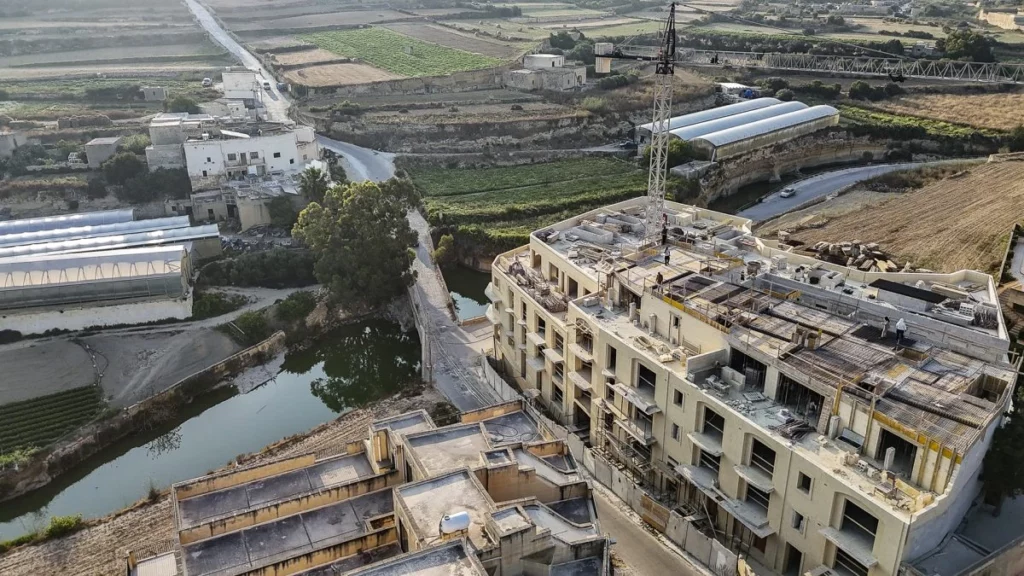
The law began to catch up with the Planning Authority’s decisions on the number of floors in January of 2023, when the Environment and Planning Review Tribunal, which hears and decides on appeals against planning permits, revoked a permit for a block of 54 flats and 36 garages on the side of a valley in the outskirts of Rabat, Gozo. This is another development belonging to the property magnate Joseph Portelli and his partners. The tribunal held that a building at that site had to be limited to three storeys and not five storeys as approved.
At the time of writing, however, the building was nearing completion – the developer eventually prevailed after a series of subsequent decisions. First, the Court of Appeal revoked the tribunal’s decision on the legal technicality of ultra vires, ruling that the tribunal had gone beyond its powers when it delved into an analysis that went further than the parameters of the appeal. The Planning Authority then granted a new permit, and a further appeal failed after a new tribunal held that the case had become res iudicata (already decided by a court).
The building of five floors now towers over a relatively narrow road that skirts a valley popular with walkers. The road is getting busy with motorists bypassing other roads, and is set to become busier still once the 54 flats are inhabited, further affecting the peacefulness sought by walkers in the first place.
In yet another case, in July of 2023 the Court of Appeal reconfirmed the revocation of the permit of a building named Park Lane in Hal Balzan. It was set to be the one of the largest, if not the largest, residential developments in central Malta, consisting of 88 flats and commercial areas including shops.
In its judgment, the court was clear: “Additionally this Court cannot but emphasise that a development cannot except for exceptional reasons have more floors than indicated in the Local Plan for as long as the same plan does not indicate otherwise.”
A few months later the same Court of Appeal revoked the block of 29 flats built by Francesco Grima in Xewkija. In that case the court held there was actually no conflict between the Local Plan and DC15 on height: that the Local Plan defined the height in number of floors and DC15 set the height limitation in metres within the number of floors set in the Local Plan. But despite this ruling, as reported above, the PA has now sanctioned the block of flats “as built” when the court revoked the permit.
In a nod to the court decision, it slapped the developer with a fine. This appears contradictory: while the Planning Authority maintained that five floors are allowed, contrary to the court’s decision, at the same time it fined the developer before sanctioning the building “as built.”
The initial government response to the courts’ revocation of permits can be found in an article published in the newspaper Malta Today last September. The article reported that an unnamed “high ranking government official” pointed to “discrimination” affecting well-known developers, insinuated that some NGOs were being weaponised by commercial interests, and faulted the courts. The Malta Today article was based on an article in Gozo Today, a newspaper produced for the Ministry of Gozo by the same publishing house that publishes Malta Today.
The official reportedly told Gozo Today that “the courts are deciding that the Local Plans, which are nearly 20 years old, should outweigh more recent policies that are intended to reflect today’s urban planning requirements”.
As already pointed out, it is the law that gives the Local Plans primacy over DC15 policies.
The official was reported to have highlighted that some projects were going ahead while others were having their permits revoked by the court. He “hinted at a growing perception that some NGOs might be weaponized by competing commercial interests to obstruct developments”.
He also claimed that the situation – of revocations – was creating inconsistency in the heights of buildings along the same streets.
The official then lamented the “confusion” and “discrimination” brought about because well-known developers were more likely to attract objections and legal challenges. The official argued that, in the words of the newspaper, the “stark contrast in how projects are treated has ignited debates about the fairness and effectiveness of the current system”.
Some of the same lines of reasoning also appear in the official planning document that set out the review of policy P35 – the policy on heights – in DC15 a month later, in October of 2024.
The official said: “An uneven playing field has also been created when cases which make their way to the courts (when planning disputes arise) are having their overall heights reduced [sic] when other neighbouring properties, which are not objected to, proceed to construct the number of levels as originally approved [sic] ultimately result in the incongruous streetscapes which the judicial process is supposedly attempting to prevent.”
So instead of moving to ensure that Planning Authority decisions became aligned with decisions of the Court of Appeal, and the law is upheld, the government proceeded – as the anonymous high-ranking official indicated in the article – to carry out a trio of policy manoeuvres to overcome the court decisions based on law.
As reported above, the first was the review of the policy on heights in DC15 to specify the number of floors that would be allowed (this number being higher than imposed in the Local Plans, despite Local Plans having primacy in law).
The second manoeuvre was Circular 2/24 listing height limitation in metres for different zones in line with DC15.
And the third was an amendment in the interpretation document of the Local Plans to refer to Circular 2/24 when it comes to height limitation.
These changes have led the Planning Authority and the Environment and Planning Review Tribunal to give short shrift to any arguments invoking the number of floors stipulated in the Local Plans.
“We have yet to test the issue of primacy of the Local Plan in court since the latest policy changes of last year, but at the level of the planning boards and planning tribunal, they are no longer receptive to arguments on limits of number of floors set in the Local Plan,” said Torpiano. “So we do not mention the height limitation in number of floors, and instead we emphasise other policy breaches now in our objections.”
Asked if he thinks the policy changes are legal, Torpiano said: “From the legal point of view, I think Local Plans are still supreme, so nothing seems to have changed. But then I ask, so why did they make these policy changes? Simply because they hope that no one challenges them and things will carry on as they wish? Are they daft? Or is there something we are not seeing?”
The analysis carried out for this investigation suggests that the government may have taken a leaf out of the judgment of the Court of Appeal in the case of the revoked development in Hal Balzan, to conjure up a reinterpretation of building heights and floor limits by changing the relevant interpretation section of the Local Plan.
But the linkage – or the proverbial bridge – from the interpretation section to the Circular 2/24 and DC15 is a superficial patch-up. The specific height policy maps in the Local Plans remain unchanged, showing limits in number of floors for every location, and these maps hold the greater weight of detail and specificity.
The Court of Appeal also revoked other permits in 2023 whenever they were granted on the back of policies that conflicted with the Local Plan. In two cases the court revoked the upper floors – a row of penthouses – of two blocks of flats belonging to Joseph Portelli and his partners at the edge of Sannat near Ta’ Cenc. This time the revocation was over insufficient recessing of the top floor as stipulated in the Local Plan.
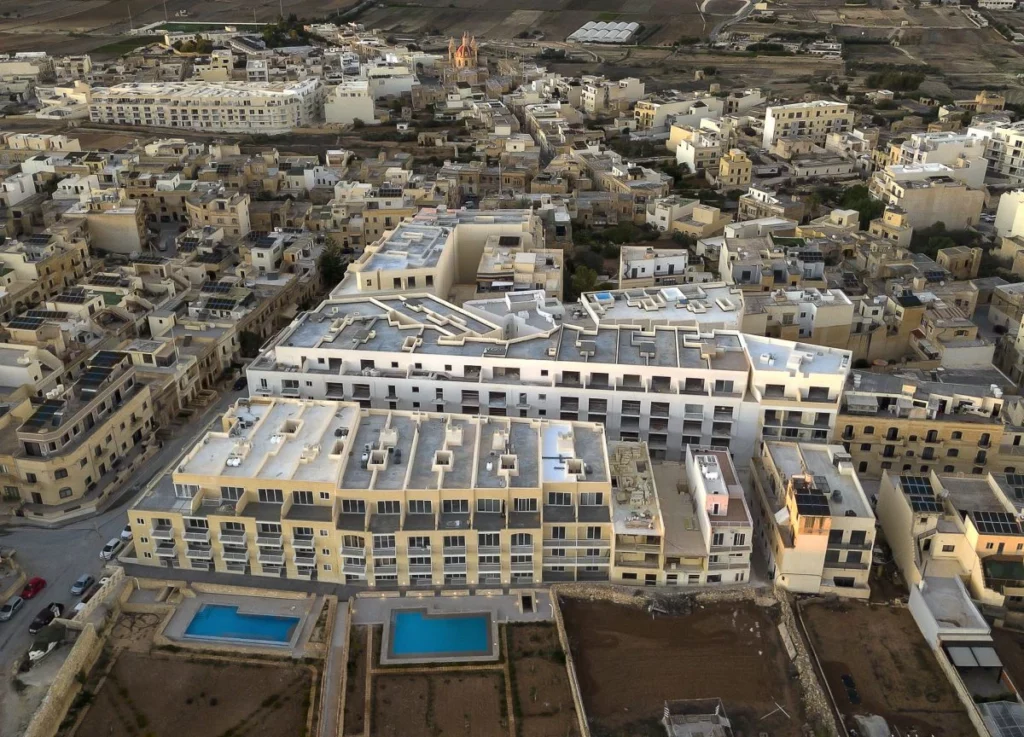
These judgments too serve to highlight the clash between the Local Plans and other policies, including guidance provided by the Executive Council of the Planning Authority.
Following the revocation, an Indian individual who reportedly works for one of the developers applied for the original permits of two of the penthouses to be regranted. The Planning Authority duly reissued the permits under the so-called summary procedure – a procedure in which certain classes of small, internal developments are granted a permit directly by the case officer, without going to the board and public hearings.
No mention was made in the Case Officer Report that the earlier permits granted for the penthouses had been revoked by the Court of Appeal.
The NGO Din L-Art Helwa, whose legal challenge had led to the revocation of the permits in the first place, then filed new proceedings for revocation in front of the Planning Authority. Last month, the authority’s Planning Board rejected the NGO’s request. This decision has caused further confusion about policies and their interpretation, especially in places where policies or zoning are partially changed.
It was several weeks after the permits were regranted in this case that the Chief Justice warned of the consequences for Malta’s democracy and rule of law if court decisions are ignored by “public authorities.” The European Court of Human Rights views public authorities ignoring court decisions as being in violation of the fundamental right to fair hearing (Article 6).
Applications for sanctioning of the other penthouses in the same buildings whose permits were revoked have since been put in and are pending.
The Court of Appeal also revoked permits for two swimming pools at the back of the two developments because they fell beyond the development zone. In its reasoning, the court referred to the fact that the pools are separated from the buildings by a public footpath. It also made it clear that swimming pools behind buildings falling beyond the development zone could only be given a permit if the pool is sited within the “curtilage” of an existing building with a valid permit or one that has existed since before 1978.
That is the requirement of Policy 6.4 of the Rural Policy and Design Guidance, published in 2014. But here, once again, for the past 10 years, the Planning Authority has been regularly granting permits for swimming pools that fall beyond development lines at the back of new buildings – decisions that pervert the requirements of the policy.
Eventually the Court of Appeal caught up with this practice and, last year, revoked permits for three swimming pools, including the two mentioned above, in developments belonging to Joseph Portelli and his partners.
In response, the developers in the case of the Sannat buildings have applied to remove the “pedestrian footpath”, which leads from one road to another, proposing instead an “area for private open space”, as per the architectural drawing put in with the application. The application is pending. Meanwhile the pools have been kept filled and clean, supposedly ready for use.
It also appears that the Planning Authority is prepared to continue to grant permits for similar pools despite these consistent court judgments. One such case was decided in April 2025. In an application for a block of flats on land that belongs, or used to belong until recently, to Ghasri’s mayor Daniel Attard, the Case Officer Report did not object to two pools in the Outside Development Zone (ODZ) behind the block of flats. The Case Officer Report asserted: “The proposed pool and decking areas each have an approximate area of 75 square metres as required in policy 6.4 of the Rural Policy and Design Guidance, 2014.”
No mention was made of the judgments of the Court of Appeal that revoked permits for pools in similar instances. Only when an objector – the author of this article – made reference to the Court of Appeal’s judgments did the applicant remove the swimming pools outback from the architectural drawings.
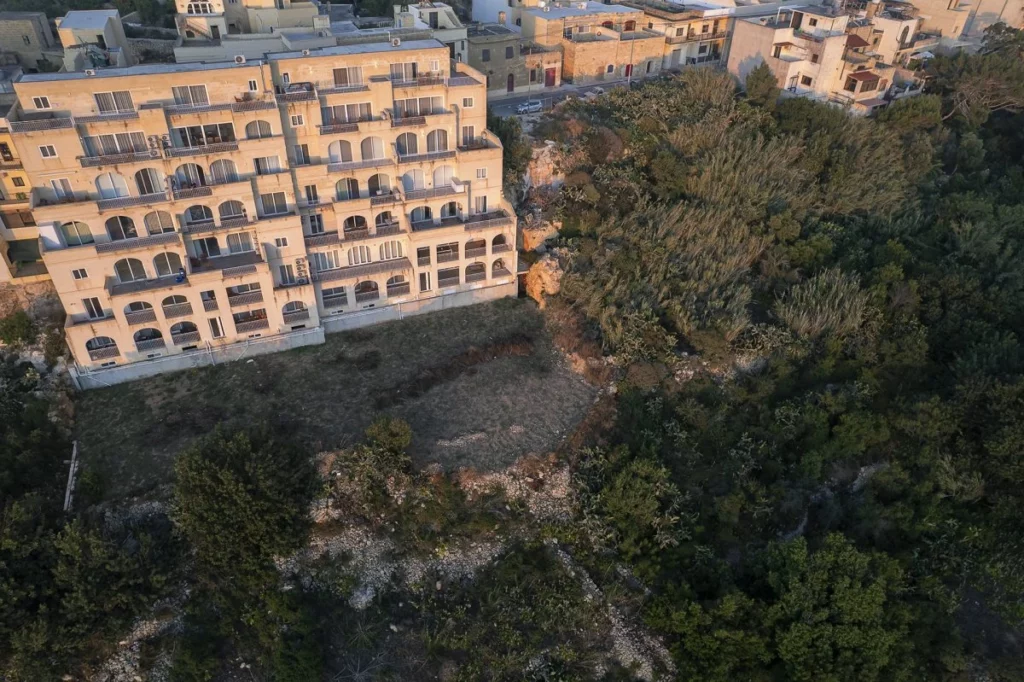
Whether it is the number of floors or swimming pools in Outside Development Zone, the pattern that emerges is of a Planning Authority taking decisions in breach of planning laws. And when the court starts revoking planning permits, the Planning Authority either ignores the court judgment or shifts the policy goalposts.
Where does this leave us legally?
In his legal opinion, when discussing the issue of the number of floors, Mizzi argues that the “the precedents [court decisions] indicate that any permit granted under the new interpretation – if it allows more floors than the maps in the Local Plan specify – may still be found to breach planning law if challenged.
“The consequence,” he writes, “is a widening gap between what is done in practice and what the law prescribes – a situation that creates legal uncertainty for all stakeholders.”